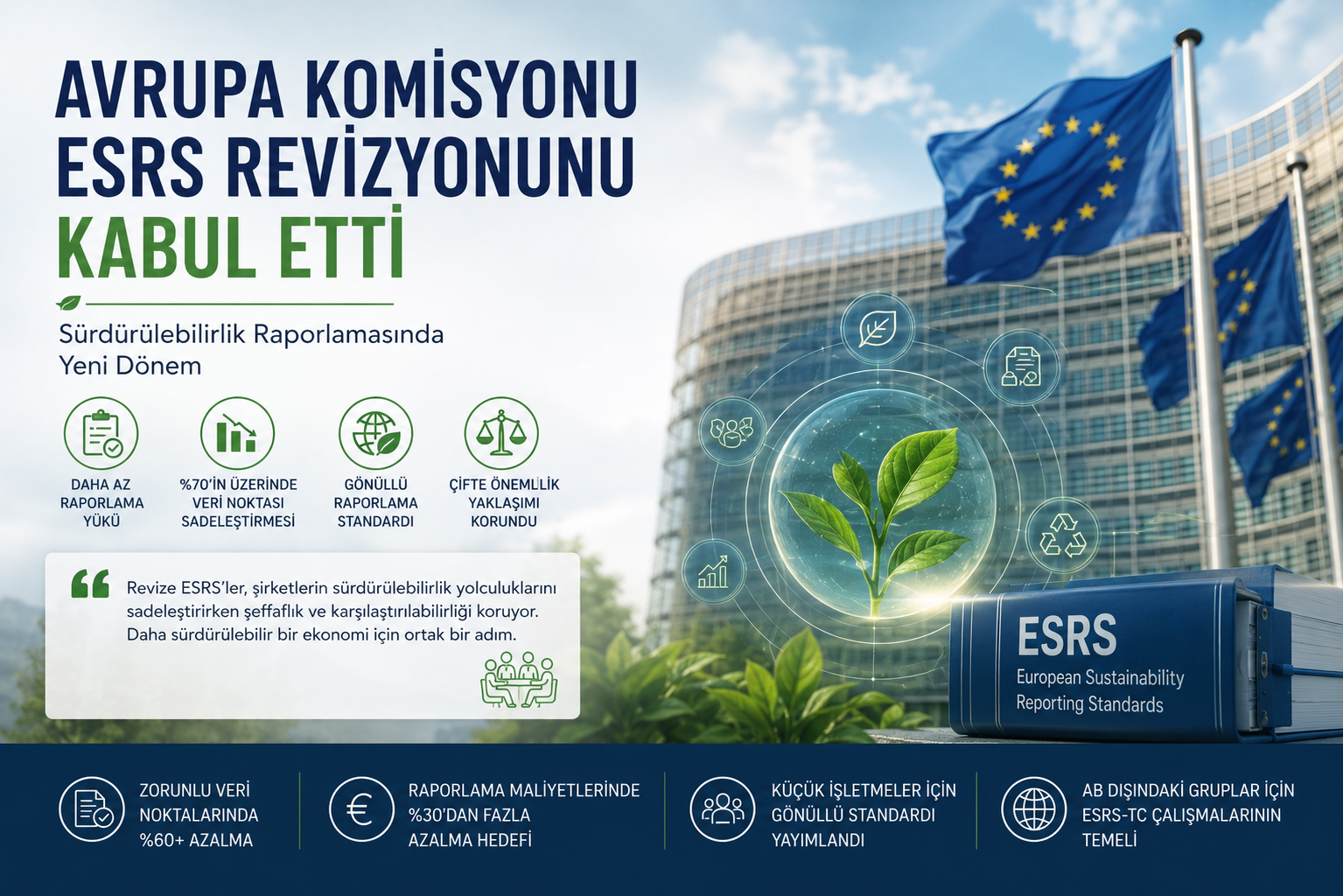
The European Commission has officially adopted the revised European Sustainability Reporting Standards (ESRS) and the voluntary sustainability reporting standard for small businesses that fall outside the scope of the CSRD.
The revised ESRS will apply to fiscal years beginning on or after January 1, 2027. Companies that wish to do so may adopt them early, effective as of the 2026 fiscal year. The standards will also serve as the basis for the development of ESRS-TC (Third Country Standards) for groups with parent companies outside the EU.
The new regulation aims to reduce the reporting burden as part of the Omnibus I streamlining package.
However, the following basic principles are upheld:
• The Double Materiality approach remains in place.
• The requirement to disclose anticipated financial effects remains in place. However, the transition period for these disclosures has been extended to 2031.
• While upholding the “Fair Presentation” principle, the goal is for the reports to provide information that truly assists investors in making decisions, rather than serving merely as a compliance checklist.
• The requirement that workers’ wages be assessed not only against the statutory minimum wage but also within the framework of the ILO’s Living Wage approach remains in effect.
However, there are also significant changes compared to the first version
The Commission deviated from EFRAG’s technical recommendations in certain areas.
• Companies have been granted significantly more flexibility regarding the scope of GHG emissions calculations. They can now choose any of the following methods: financial control, operational control, or equity share. This may reduce comparability among companies and lead to organizational boundaries being defined in different ways.
• The reporting requirement for secondary microplastics has been removed. As a result, reporting will now cover only intentionally produced microplastics.
• The obligation to disclose human rights violations has also been narrowed. Companies will now be able to report not all complaints, but only those cases that have been verified based on their own assessments or finalized by court rulings.
The process is not yet complete
The revised ESRSs and the voluntary reporting standard have now been submitted to the European Parliament and the Council of the EU for review.
If no objections are raised during the two-month review period (which may be extended to four months if necessary), the regulation will be published in the Official Journal of the European Union and enter into force.