For many years in climate negotiations, oceans remained a peripheral topic in the discussion — they did not feature as prominently as forests, energy transition, or greenhouse gas emission targets. Yet, we are talking about a system that covers 70% of the planet’s surface, absorbs a large portion of the carbon we produce, and provides a livelihood for billions of people. The ‘Ocean and Climate Change Dialogue 2026’ report, published on August 31, 2026, by the UN Framework Convention on Climate Change (UNFCCC), represents the latest effort to rectify this imbalance.
The report summarizes the sessions and dialogues held in Bonn on June 10-11, 2026, and also includes concrete messages that parties should address leading up to COP31, which will take place at the end of this year.
The dialogue’s origins lie in the 2021 Glasgow Climate Pact, when parties decided to establish an annual platform to discuss how ocean-based action could be better integrated into climate processes. Five years later, the discussion has evolved from “why should we care about the ocean” to “how do we make ocean-based action implementable, measurable, and financeable”.
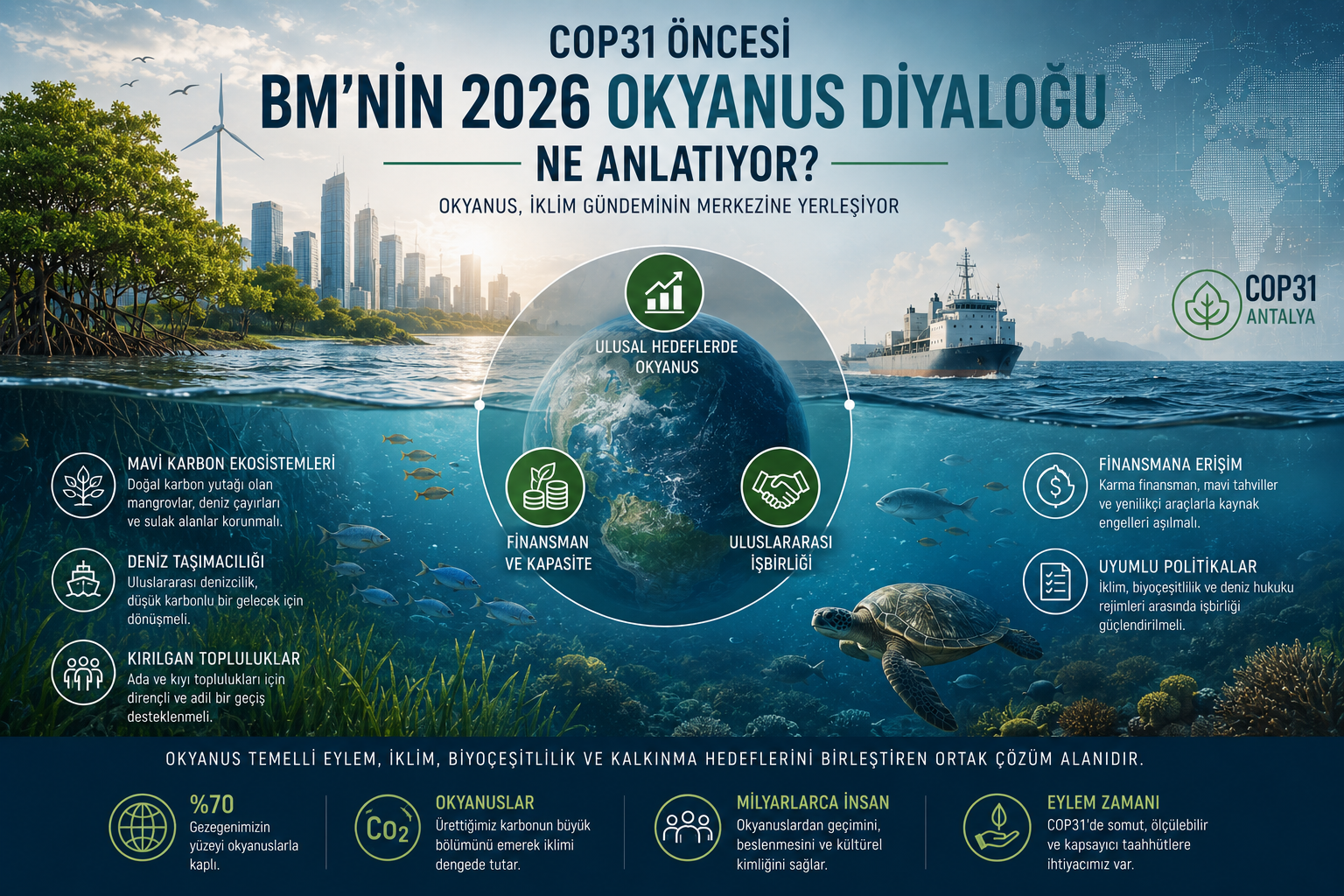
The 2026 dialogue addressed this transformation along three main axes: the role of the ocean in national climate targets (NDCs), the financing and capacity to implement these targets, and international cooperation among ocean-climate-biodiversity agendas.
One of the key points emphasized by participants was that ocean-based climate action would not proceed with a “one-size-fits-all model.” While the priority for an island nation might be combating coastal erosion, for a country with a large coastline, the issue could be the decarbonization of maritime transport. The report presents this diversity not as a weakness, but as a strength sensitive to national conditions.
Nevertheless, a common need clearly emerged: the strengthening of measurement and accounting infrastructure. Reliably calculating how much carbon “blue carbon” ecosystems, such as mangroves, seagrasses, and coastal wetlands, sequester is still a technical gap for many countries. Japan’s inclusion of quantitative blue carbon targets for 2035 and 2040 in its NDC, along with the development of an accompanying credit system, is highlighted in the report as a concrete example. Brazil’s “Blue NDC Implementation Task Force,” conducted jointly with France, is also an effort to build a similar implementation bridge.
Perhaps the most striking finding of the report lies in the section concerning financing. Contrary to popular belief, the problem is not primarily that countries are not ambitious enough regarding the ocean; rather, it is their inability to access existing financing and utilize it effectively. Complex application processes, high transaction costs, fragmented funding windows, and a lack of “bankable” projects — that is, projects prepared to be financeable for investors — prevent many countries, especially island nations and least developed countries, from realizing their goals.
Data presented by the OECD concretizes this picture: ocean-based official development assistance will constitute only 1.3 percent of total development assistance in 2024. In contrast, the report proposes a “holistic financing” approach, bringing together public, concessional, private, and blended finance, innovative instruments such as blue bonds and parametric insurance, and mechanisms like GEF-9 (the ninth cycle of the Global Environment Facility) as solutions. It is emphasized that the 2026 Standing Committee on Finance Forum offers a concrete short-term opportunity to overcome these obstacles.
The report’s third pillar, perhaps the most systemic, is the disconnected operation of climate, biodiversity, and marine law regimes. The Paris Agreement, the Convention on Biological Diversity, and the recently enacted BBNJ Agreement (on the conservation of marine areas beyond national jurisdiction) still largely function independently. Participants called for the establishment of common indicators, harmonized reporting processes, and regular dialogue among these three conventions, the International Maritime Organization, and the Ramsar Convention.
The entry into force of the BBNJ Agreement is referred to as a positive milestone throughout the report; however, it is also noted that it is still in an early implementation phase and needs to learn lessons from existing climate and biodiversity processes.
The report is quite clear on the next steps: ocean-based climate action should be presented as a cross-cutting priority at COP31 and in the preceding Pre-COP process. The co-facilitators propose that the dialogue should move beyond being merely a discussion platform and transform into a multi-year roadmap linked to the ambition and implementation cycle of the Paris Agreement. Thus, each year’s dialogue will become part of a traceable process, building upon previous years.
Consequently, the report states that oceans are no longer a side topic in climate negotiations, but a central area where mitigation, adaptation, finance, and biodiversity agendas intersect. The main question is whether this awareness will translate into concrete, measurable commitments at COP31.
This article is based on the UNFCCC’s official summary report, “Ocean and Climate Change Dialogue 2026,” dated August 31, 2026.