For a long time in the corporate world, sustainability was a passive agenda kept within the boundaries of compliance reporting and corporate communication campaigns. However, tectonic shifts in global trade architecture have removed the climate crisis from being a matter of environmental awareness and made it a primary factor directly determining macroeconomic stability, borrowing margins, and market share dynamics. Today, climate risk is a fundamental financial parameter that directly shapes balance sheet bottom lines, the cost of capital, and the ability to survive in global markets.
In the current era, institutions that fail to place climate resilience and low-carbon strategies at the center of their business models face not only regulatory pressure, but also direct existential threats such as isolation from capital, exclusion from supply chains, and asset devaluations.
Financial markets are rapidly abandoning traditional valuation methods that rely on historical data for risk measurement. The uncertainties created by non-linear climate risks and regulatory transition processes are fundamentally altering capital allocation mechanisms.
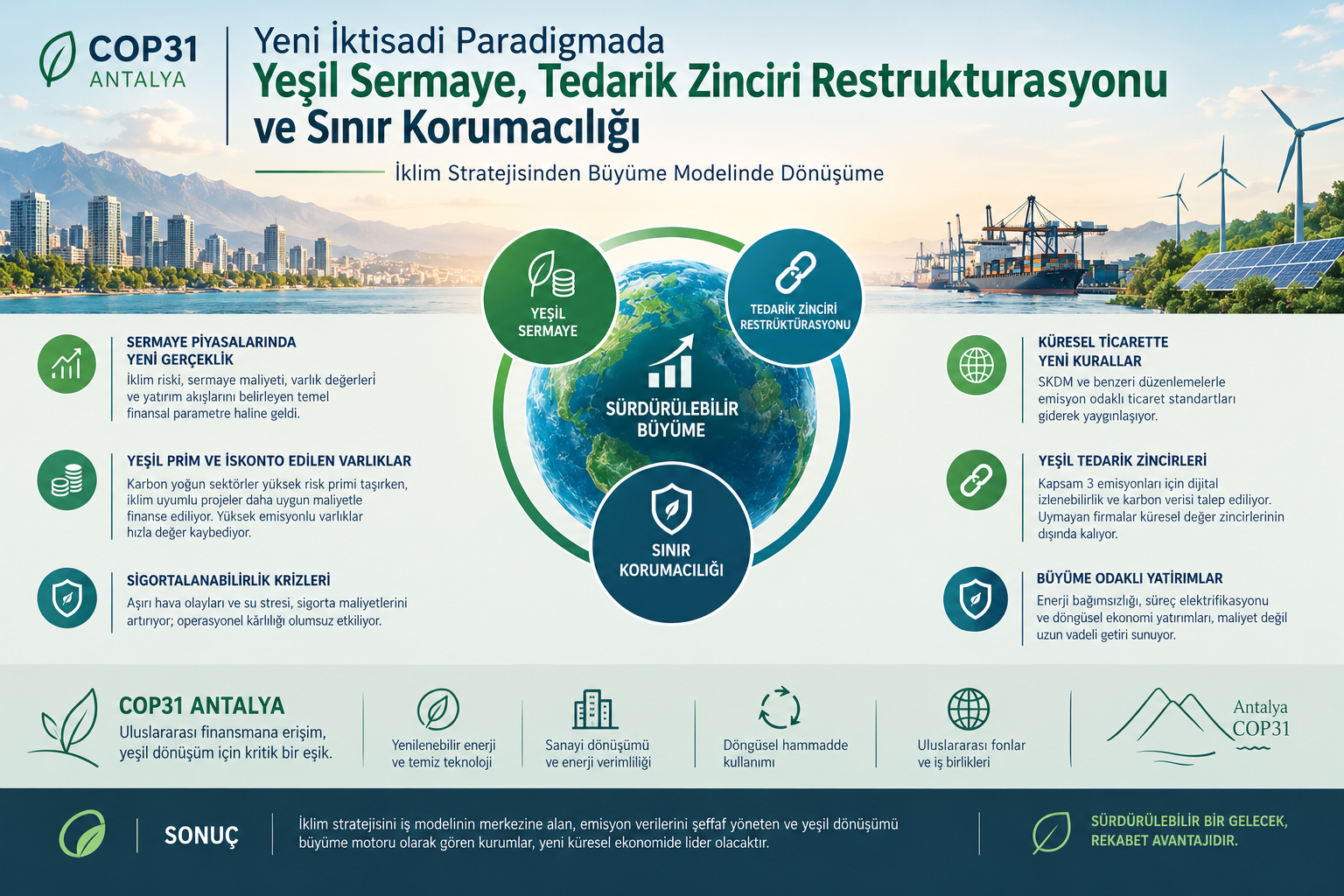
This new reality in capital flows manifests across three main axes:
Divergence in the Cost of Capital (WACC): International financial institutions and funds are restructuring their investment portfolios in line with Net Zero targets. Companies without a measurable decarbonization path are penalized with high risk premiums and an increased Weighted Average Cost of Capital (WACC), whereas climate-aligned projects borrow under more favorable terms through the “greenium” advantage.
Stranded Asset Dynamics: High-emission production infrastructure and energy-inefficient real estate stocks are rapidly reaching the end of their commercial lives due to tightening emissions trading systems and carbon taxes. This exposes trillions of dollars in assets on balance sheets to sudden impairment risks.
Insurability Crises: Securing insurance policies for industrial facilities in regions with escalating physical risks—such as water stress, floods, and extreme heatwaves—is becoming increasingly difficult, with rising premium rates directly eroding operational profit margins.
In foreign trade, traditional customs duties are gradually giving way to emission-focused regulations. This process, which began with the European Union’s Carbon Border Adjustment Mechanism (CBAM), is turning into a global standard through similar trade policies across US and East Asian markets.
International prime manufacturers are demanding digital traceability and Carbon Footprint data from sub-suppliers in line with their Scope 3 emission reduction commitments. Companies unable to measure and verify their emission data according to international standards risk being completely excluded from global value chains, regardless of product quality or price advantages.
While decarbonization expenditures were viewed in previous years as a one-sided operational burden, today’s cost landscape demonstrates that these investments offer a clear Return on Investment (ROI).
Energy Independence and Cost Predictability: Power Purchase Agreements (PPAs) for renewable energy and self-consumption rooftop solar/wind investments shield industrial enterprises from volatile fossil fuel markets, providing long-term margin stability.
Process Electrification and Circular Economy: Implementing electrification on production lines and establishing closed-loop waste/water recovery systems reduce reliance on raw materials while directly lowering carbon tax liabilities.
Operational Resilience: Facility-level infrastructure reinforcements and the creation of alternative supply routes prevent massive financial losses caused by climate-driven production disruptions.
The COP31 Summit, hosted by Turkey, represents a critical turning point for the integration of the regional industrial and financial ecosystem into global green transformation mechanisms.
Global targets highlighted within the scope of the summit—such as increasing the share of electrification in industry, reducing energy intensity in buildings, and boosting circular material use—provide a concrete roadmap for the Turkish business world. International funding mechanisms like the Climate Implementation Bridge, set to stand out in this process, will facilitate the access of renewable energy, clean tech, and industrial transformation projects to low-cost global climate finance.
The negotiations in Antalya will clarify the rules of global trade and the direction of capital flows for the coming years. Institutions that interpret this transformation process as a strategic opportunity and accelerate their compliance steps will gain a competitive advantage in the new economic order.
Conclusion
Climate change is a fundamental economic reality rewriting the direction of capital flows, trade laws, company valuations, and production models.
Companies that integrate physical and transition risks into their strategic decisions, manage emission data transparently according to international standards, and position green transformation not as a cost element but as a growth engine will take the lead in tomorrow’s global market. On the path to COP31 Antalya, sustainability has ceased to be a corporate image exercise and has become the sole prerequisite for existing and competing in the international arena.