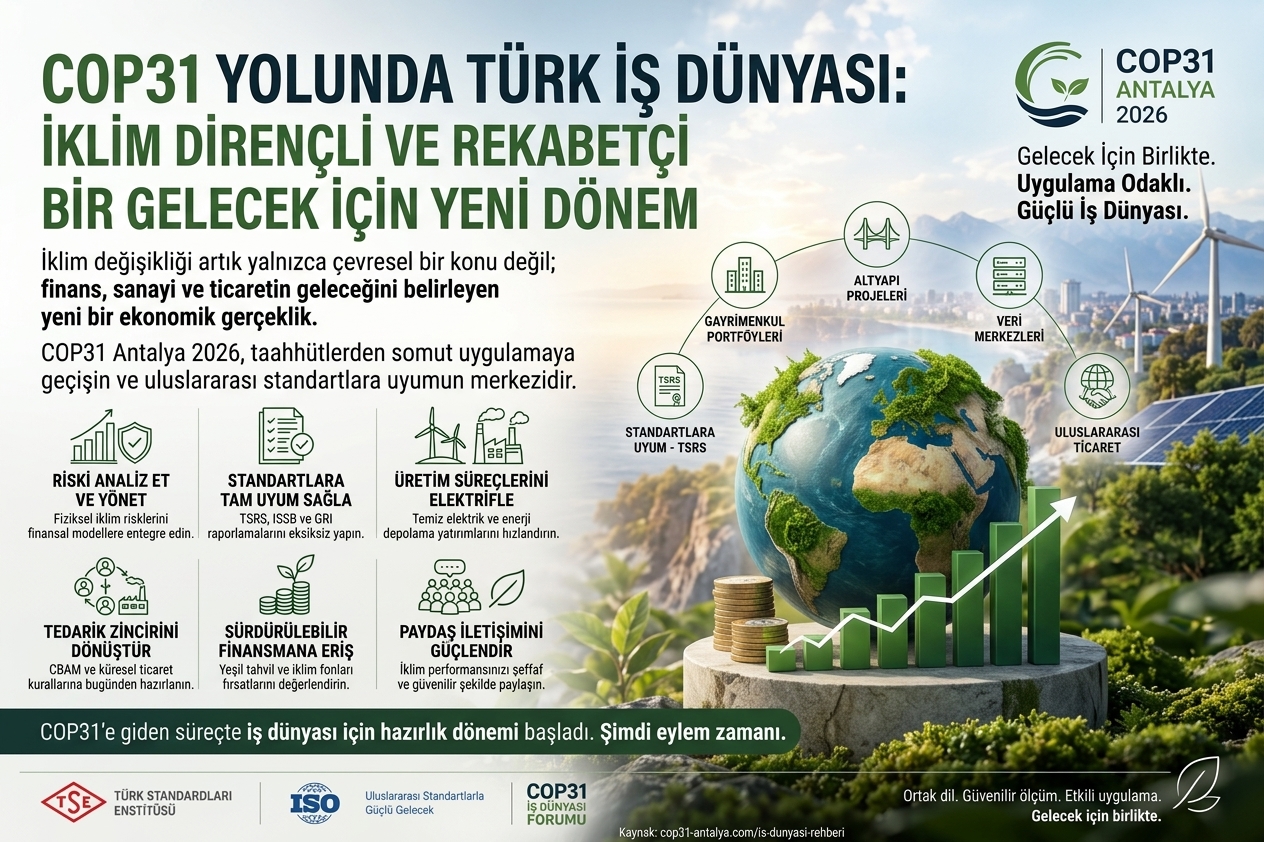
For many years, climate change was largely considered an environmental problem. However, the picture has completely changed today. Increasing natural disasters, stricter climate policies, carbon costs, and international standards directly affect companies’ financial performance, investment decisions, and export capacity.
For Türkiye, which will host COP31, this process represents not only a global event but also a significant turning point that will shape the future of business.
In the past, companies largely based their financial planning on historical data. However, climate change is making this approach increasingly obsolete.
Extreme temperatures, floods, droughts, wildfires, and supply chain disruptions not only create operational problems; they also increase insurance costs, raise investment risks, and affect company valuations.
Today, investors are looking not only at companies’ current performance but also at how prepared they are for future climate-related risks. For financial institutions, climate resilience is becoming a crucial part of credit ratings and investment analysis.
The green transition is not just about reducing emissions.
It is becoming increasingly critical for companies to accurately calculate their carbon footprint, reliably report sustainability data, and comply with international standards.
TSRS, GRI, ISSB and similar sustainability standards are no longer just reporting tools; they are seen as fundamental components of investor confidence, access to finance and international trade.
Companies that cannot measure cannot manage, and companies that cannot manage begin to lose their competitive advantage.
The European Union’s Emissions Trading System (ETS) has long been one of the most important tools for carbon pricing.
Recently, the impact of the Electronic Trade System (ETS) on competitiveness in European industry has been intensely debated. Energy-intensive sectors, in particular, argue that rising costs are challenging their global competitiveness, and various regulatory proposals aimed at making the system more balanced are being put forward.
However, the common point of the discussions is noteworthy:
Nobody thinks the carbon economy will end.
Instead, the discussion is focusing on how to implement carbon pricing more effectively. This sends an important message to companies: In the competition of the future, carbon management is no longer a temporary agenda, but a necessity for a permanent business model.
.
Türkiye hosting COP31 is not just a diplomatic success.
This process presents a significant opportunity for all stakeholders, from public institutions to the private sector, to accelerate their sustainability transformation.
Issues such as carbon management, sustainable financing, green investments, climate technologies, and compliance with international standards will become much more visible in the coming years.
Therefore, it is critical for companies to prepare today, not only to fulfill legal obligations but also to gain a competitive advantage in the future.
Climate change is no longer just an environmental issue; the new reality of finance, commerce and industry.
Physical climate risks affect company balance sheets, sustainability standards shape investment decisions, and carbon markets set the new rules of international competition.
The lead-up to COP31 marks a crucial period for Turkey, where this transformation will accelerate. The strong companies of the future will not only be those that produce, but also those that manage climate risks, report their data accurately, and comply with international standards.
Because in the new economy, sustainability is no longer a choice, but one of the fundamental conditions for competitiveness.