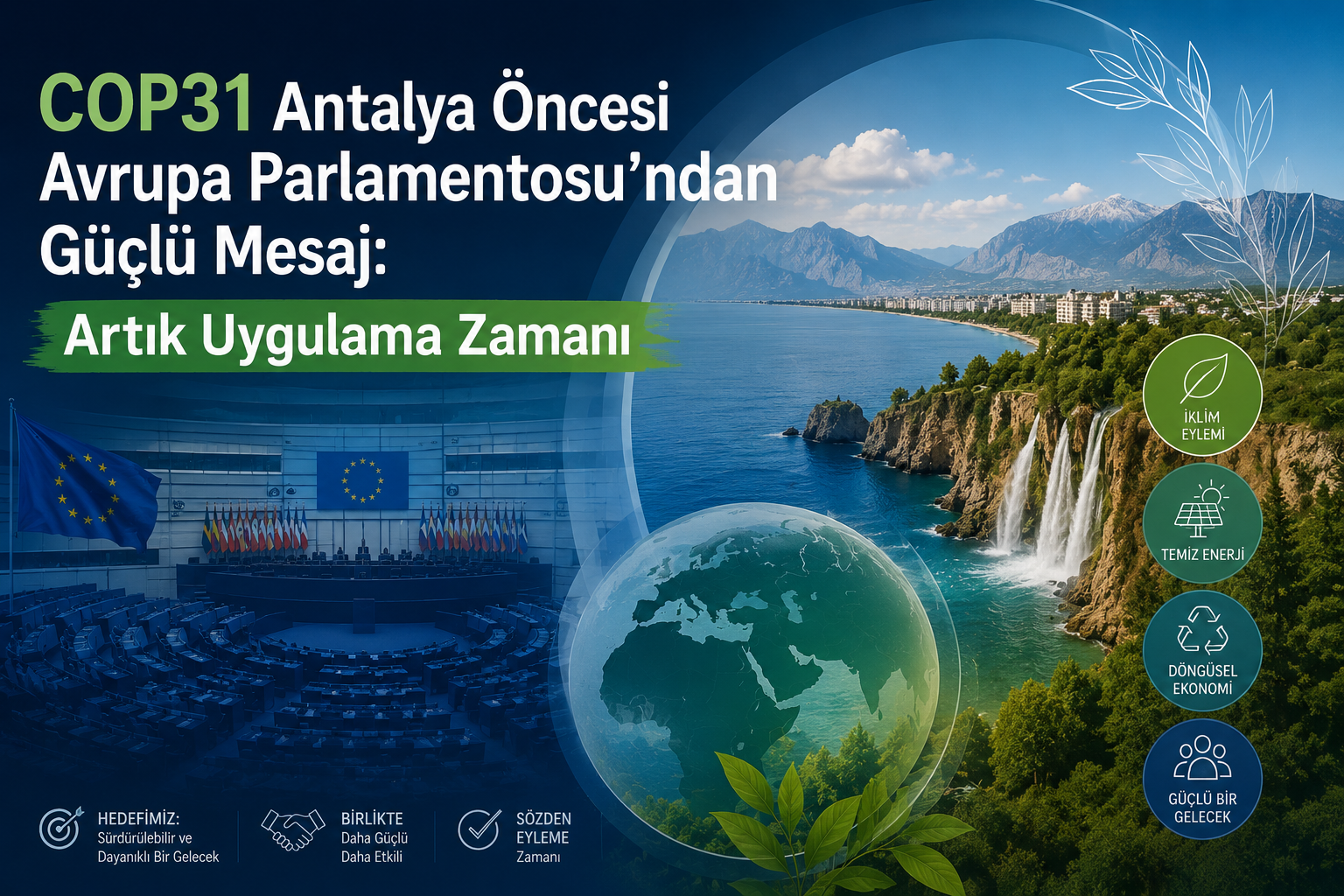
On July 3, 2026, the European Parliament’s Committee on Environment, Climate and Food Safety (ENVI) evaluated proposed amendments to the parliamentary resolution being prepared ahead of the COP31 Climate Summit, scheduled to take place in Antalya in November. Although this work—comprising approximately 200 proposed amendments—does not yet represent the European Parliament’s final position, it offers significant indications regarding the priorities with which the European Union will approach the COP31 negotiations.
Discussions at recent COP summits have primarily focused on countries’ new commitments, net-zero targets, and long-term visions. However, the European Parliament argues that the focus needs to shift.
According to Parliament, the fundamental question should no longer be “Will a new target be announced?” but rather “How will the existing targets be achieved?”
Therefore, the document strongly emphasizes the need to close the implementation gap that emerged following the Paris Agreement’s first (Global Stocktake) for countries to support their 2035 Nationally Determined Contributions (NDCs) with concrete policies and investments, and to accelerate emission reductions.
Perhaps the most striking aspect of the document is the strong support given to the Global Climate Action Agenda announced by the COP31 Antalya Presidency.
The amendment proposals submitted by members of parliament suggest explicitly incorporating into the decision text many of the topics highlighted by the Antalya Presidency.
These include, in particular, topics such as the following:
One of the most frequently repeated concepts in the document is electrification.
The proposals aim not only at renewable energy investments but also at accelerating electrification across numerous sectors, ranging from transport and buildings to industry and final energy consumption.
Some proposals even suggest establishing a shared target for the global electrification rate by 2035. In addition, support is being expressed for the “Electrify Now” initiative, launched in collaboration with the European Commission and the COP30 and COP31 Presidencies.
This approach indicates that, in the coming years, not only purchasing renewable energy but also transitioning fossil-fuel-based processes to electric technologies will become central to companies’ climate strategies.
Although the circular economy has been discussed in COP processes for many years, this time, for the first time, it is emerging as one of the key instruments of climate negotiations.
Parliament;
Green Industrialisation,
Circular Economy,
Circular Material Use Rate
supports the inclusion of concepts such as… within the COP31 targets.
This is a significant development, particularly for companies in the manufacturing sector, as carbon reduction will now be assessed not only based on energy consumption but also on the circularity of the materials used.
The document strongly highlights not only emission reduction but also the issue of climate change adaptation.
The European Parliament;
Implementing the Global Goal on Adaptation,
the acceleration of national adaptation plans,
expanding early warning systems,
supporting nature-based solutions
recommends.
This approach demonstrates that climate risks are no longer viewed solely as environmental risks, but also as economic, social, and operational risks.
The proposed amendments to the draft decision also support strengthening the commitments under the Global Methane Pledge.
In particular, the need to reduce methane emissions from the waste sector, agriculture, and oil and natural gas sources is emphasized.
Therefore, it can be expected that practices related to waste management, biogas, organic waste, and the circular economy, in particular, will become more visible during COP31.
The ENVI Committee meeting held on July 3rd marked the first comprehensive assessment outlining the European Parliament’s political priorities ahead of COP31. Amendments proposed by committee members signal a broad trend toward giving greater prominence to issues such as electrification, green industrialization, the circular economy, adaptation, and methane reduction on the COP31 agenda. Although the final text of the Parliament’s resolution will take shape in subsequent stages, the approach emerging from the ENVI Committee is expected to significantly shape the European Union’s negotiating position in Antalya.